
Reviewed · MUSEUMS
Paradox Museum Oslo
Your eyes will argue with your brain. Paradox Museum Oslo turns that argument into an hour of hands-on fun, with 70 exhibits built around optical illusions, sensory tricks, and reality-bending ideas. I like the central location at Rosenkrantz’ gate 11 and the fact that you can pre-book admission to avoid waiting in line.
I also like how well the museum suits mixed-age groups. Children, teenagers, parents, and curious adults can all take part rather than simply look at displays. The main drawback is value: at $30.10 per person for about one hour, it is not a cheap stop, especially since the museum is part of a wider international concept rather than something unique to Oslo.
In This Review
- Key points to know
- What the Visit Is Really Like
- Entering at Rosenkrantz’ Gate 11
- Moving Through 70 Paradox Exhibits
- Why Children and Teenagers Fit the Museum So Well
- A Staff-Assisted Photo Stop
- Is $30.10 a Fair Price for One Hour?
- Timing, Queues, and Group Size
- Who Should Book It?
- Should You Book Paradox Museum Oslo?
- FAQ
- Where is Paradox Museum Oslo?
- How long does the visit last?
- How many exhibits are at the museum?
- What kind of exhibits will I see?
- Is the museum suitable for children?
- Is Paradox Museum Oslo indoors?
- Can I skip the queue?
- Is the ticket mobile?
- Is public transportation available nearby?
- Can I cancel or change my ticket?
Key points to know
- Seventy interactive exhibits: Expect optical illusions and sensory puzzles designed to make you question what you see.
- A strong rainy-day choice: The museum gives families a practical indoor activity in central Oslo.
- Good for photos: Staff can help suggest photo opportunities, which adds fun to the visit.
- About one hour long: The compact duration works well between other sights, though some may find the price high for the time.
- Central meeting point: The entrance is at Rosenkrantz’ gate 11, near public transportation.
- Maximum group size of 30: Admission is arranged for your own group, helping you avoid a crowded tour format.
What the Visit Is Really Like
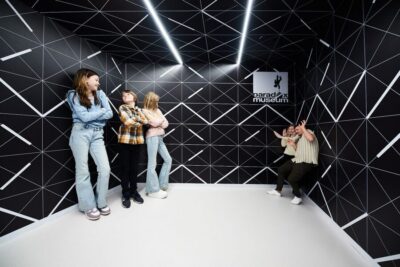
Paradox Museum Oslo is not a traditional museum where you quietly read labels and move from case to case. It is built around participation. You look, touch, pose, test your senses, and try to work out why an exhibit appears to break the rules.
The central idea is simple: your brain makes quick assumptions about size, space, movement, and perspective. The exhibits then use those assumptions against you. You may see something that appears impossible, only to understand the trick after changing your position or taking a closer look.
That makes the visit especially easy to share with children and teenagers. You do not need a background in science, art, or psychology to enjoy it. You only need a willingness to be surprised, and perhaps a little patience when your eyes insist on something your mind knows cannot be right.
The museum offers around 70 exhibits, so you get a steady run of small puzzles rather than one long presentation. That variety helps keep the pace moving. If one display does not interest you, the next may involve a completely different visual or sensory effect.
More Museums in Oslo
- Kon-Tiki Museum Entrance Ticket
★ 4.5 · 1,096 reviews - Oslo: Paradox Museum Entry Ticket
★ 4.3 · 799 reviews - The Fram Museum Admission Ticket
★ 4.5 · 490 reviews
Entering at Rosenkrantz’ Gate 11
The museum is at Rosenkrantz’ gate 11 in central Oslo, a useful location for fitting this stop into a day of sightseeing. It is near public transportation, so you do not need to build a complicated journey around it.
A mobile ticket makes entry straightforward. Pre-booking is particularly useful if you want to go at a certain time, since the ticket is designed to help you skip the queue. That matters most during poor weather, school holidays, or busy periods when an indoor attraction can become a natural backup plan for many families.
The activity begins and ends at the same location. You should allow about one hour for the museum itself, with no separate transfer between the starting and finishing points.
The admission format is intended for your own group, rather than placing you into a large guided sightseeing party. The stated maximum is 30 people. That is not a tiny private visit, but it does keep the arrangement more contained than a large city tour.
Moving Through 70 Paradox Exhibits
Once inside, you move from one interactive display to the next. The exhibits are based on paradoxes, optical illusions, and sensory effects. The point is not just to admire a clever design. It is to test what you think you are seeing.
You might find yourself checking an object from different angles, comparing what your eyes report with what your hands or sense of balance suggest, or trying to create a convincing image with a companion. The museum encourages this kind of active testing.
That is where the photo element comes in. Staff can help suggest good photo opportunities, which is a real plus for families and teenagers. A clever illusion often makes more sense in a picture than in a verbal explanation, and the process of setting up a pose gives everyone another reason to participate.
The best way to approach the exhibits is to take your time with the ones that confuse you. A rushed visit can turn the museum into a quick sequence of snapshots. If you stop to ask why an illusion works, you get more than a collection of amusing pictures. You get a simple lesson in how easily perception can be fooled.
Still, do not expect a formal educational tour with a guide explaining every station in depth. The appeal comes from figuring things out yourself. Adults who prefer detailed historical displays may find the presentation light, while families often appreciate that it does not demand long periods of quiet attention.
Why Children and Teenagers Fit the Museum So Well
This is one of the clearest strengths of the attraction. Children can interact with the displays, and teenagers have plenty of chances to take photos and test the illusions with friends or family.
The experience also gives a group a shared activity. Instead of splitting up because one person wants art and another wants entertainment, you can work through the puzzles together. A parent can challenge a child to explain what is happening, while older children may enjoy showing adults how easily the eye can be fooled.
The museum is suitable for all ages, but that does not mean every exhibit will appeal equally to every person. Younger children may enjoy the visual surprise without caring about the explanation. Adults may be more interested in the psychology behind the illusion. The visit works best when you let each person respond in their own way.
A useful expectation is to treat the museum as playful entertainment with a science and perception angle. It is not a major Oslo landmark, and it does not tell you much about Norwegian culture. Its value lies in the shared fun and the chance to do something different indoors.
A completely different kind of day out from Oslo:
- Oslo: Scenic Fjord Cruise with Audio Guide Commentary
★ 4.5 · 5,375 reviews - Oslo Nature Walks: Island Hopping Tour
★ 4.8 · 2,713 reviews - Oslo: 100% Electric Oslofjord Sightseeing Cruise
★ 4.4 · 2,041 reviews - Oslo: Fjord Evening Cruise with Shrimp Buffet
★ 4.5 · 1,956 reviews
A Staff-Assisted Photo Stop
Staff assistance is one of the details that can make the visit run better. At the exhibits where the camera angle matters, a staff member can suggest how to pose or where to stand. That saves you from repeatedly taking pictures that do not show the illusion properly.
I especially like this for families. One adult is often left trying to photograph everyone else, while the children rush ahead. A little guidance helps the group get a better result and keeps the photo process from becoming frustrating.
You should still keep your expectations sensible. Staff help with photo opportunities does not turn the visit into a professional photo session. The museum remains a self-guided, interactive attraction. The assistance is best seen as a helpful nudge when an exhibit needs the right angle or framing.
The photo side also explains why the museum can feel more enjoyable with two or more people. A solo visitor can still explore the exhibits, but many illusions are more entertaining when you can compare reactions, take turns, and create pictures together.
Is $30.10 a Fair Price for One Hour?
The listed price is $30.10 per person. For an attraction lasting about one hour, that is a fairly serious admission cost. You should think of it as a compact, hands-on activity rather than an inexpensive filler stop.
The price makes more sense if you value three things: an indoor setting, interactive entertainment, and a central location that is easy to add to your day. A family may also find the shared activity worthwhile because everyone can take part. You are paying for the design of the exhibits and the chance to use them, not for a long guided program.
The value is weaker if you are looking for something distinctly tied to Oslo. The concept exists in other cities, so this is not a uniquely Norwegian cultural experience. You are visiting it because it is fun and convenient, not because it explains the city.
The overall rating of 3.1 from 83 reviews points to a mixed reaction, which fits the price question. The positive side is easy to understand: the exhibits can produce real laughter, the staff can help with pictures, and the central setting is convenient. The less positive side is also clear: one hour may feel brief for the money, especially for adults who move quickly through visual puzzles.
I would book it when the weather is poor, your group includes children or teenagers, or you want a break from churches, galleries, and outdoor sightseeing. I would be more cautious if your budget is tight or your Oslo schedule is already full of higher-priority sights.
Timing, Queues, and Group Size
Pre-booking gives you a mobile ticket and helps you get straight into the museum without waiting in the regular line. That is a practical benefit, though it does not change the length of the visit.
The activity is usually booked around nine days ahead, so reserving in advance is sensible if your Oslo dates are fixed. You do not need to plan months ahead based on the available information, but leaving it until the last minute could reduce your choice of times.
The maximum group size is 30 people. The experience is described as being enjoyed in your own group, which is useful if you want a family outing rather than a standard large-group tour. You should not mistake this for a private guide-led session, however. The museum itself is still a public attraction with multiple people using the exhibits.
Because the full visit takes about one hour, it pairs neatly with other central Oslo plans. It can fill a gap before lunch, offer shelter during bad weather, or give children a break when a long sightseeing day starts to drag.
Who Should Book It?
I would put Paradox Museum Oslo high on the list for families with school-age children and teenagers. It gives young visitors something to do with their hands and minds, and it does not require them to stand quietly while an adult reads long explanations.
It also suits mixed groups. If one person enjoys science, another likes photography, and someone else simply wants to laugh at a strange visual effect, the museum gives everyone a reason to join in.
Adults who enjoy optical illusions should have a good time, but I would set the right expectations. This is not a major museum of Norwegian art or history. It is a playful attraction based on a popular concept, and its main reward is the moment when your senses get something wrong.
People with service animals can bring them, and most visitors can participate. The location near public transportation adds to its convenience. Still, the available details do not provide a full breakdown of every exhibit or specific access feature, so you should contact the provider if you need information beyond the general participation guidance.
One important booking note: the ticket is non-refundable and cannot be changed for any reason. Only reserve once your plans are firm.
Should You Book Paradox Museum Oslo?
Book it if you want a cheerful, indoor activity that keeps children and teenagers involved. The 70 interactive exhibits, central location, mobile entry, and helpful photo guidance make it easy to fit into an Oslo day.
Think twice if you want a uniquely Norwegian experience or expect several hours of entertainment for the price. At $30.10 for roughly one hour, the museum is best judged as a fun shared activity, not a budget attraction.
My call is simple: families and groups of friends should consider booking, especially on a rainy day. Adults traveling alone or watching every kroner may prefer to spend the money elsewhere unless optical illusions are a particular interest.
FAQ
Where is Paradox Museum Oslo?
It is located at Rosenkrantz’ gate 11, 0159 Oslo, Norway.
How long does the visit last?
The visit lasts approximately one hour.
How many exhibits are at the museum?
The museum has 70 paradox-based exhibits.
What kind of exhibits will I see?
You will find interactive exhibits, optical illusions, and displays designed to challenge your senses and perception.
Is the museum suitable for children?
Yes. It is family-friendly and suitable for children, teenagers, and all ages.
Is Paradox Museum Oslo indoors?
Yes. It is an indoor activity, making it useful for a rainy or cold day in Oslo.
Can I skip the queue?
Pre-booking the entrance ticket lets you skip the queue and enter with less hassle.
Is the ticket mobile?
Yes. The ticket is provided as a mobile ticket.
Is public transportation available nearby?
Yes. The museum is near public transportation.
Can I cancel or change my ticket?
No. The experience is non-refundable and cannot be changed for any reason.
Just added around Oslo
- Visit the Instaworthy Spots of Oslo’s Vigeland Park with a Local★ 5.0 · 4 reviews
- Oslo: 3-hour Cross Country trip with equipment and guide★ 5.0 · 4 reviews
- Oslo: 2-hour Christmas Private Walking Tour★ 3.0 · 4 reviews
- Art and Museum Tour of Oslo★ 5.0 · 4 reviews
- Flavors of Oslo: Food & Beer Tour★ 4.8 · 4 reviews
- Private Transfer from Oslo City Centre to Oslo Airport★ 5.0 · 4 reviews
- 3-Hour Vattkørt Beginner Kayak Course on Oslo Fjord★ 5.0 · 4 reviews
- Hipstoric Grünerløkka Private Walking Tour★ 5.0 · 4 reviews
Museums, compared.

Troll Museum Entry Ticket with AR Media Experience
Read our review →


Aksla-Alnes-Giske-Sunnmøre museum 100 % Highlights 4.5 H
Read our review →Browse the lists this tour appears in