

Reviewed · WALKING TOURS
Myths and Legends: An Oslo Walking Discovery
Stories make Oslo easier to remember. This two-hour walk links Viking beliefs with ghost tales, old streets, fortifications, and city symbols. I like the mix of folklore and real places, and I like the small group cap of 16 people, which should make it easier to hear the guide. The main thing to consider is the tour’s tone: despite its title, the stories may be more entertaining and cultural than truly dark.
The 6 p.m. start gives the walk a pleasant evening feel, while the route connects Oslo City Hall, Christiania Torv, Akershus Castle and Fortress, Kvadraturen, and Oslo Cathedral. I also like that the tour finishes near Karl Johans gate, right in central Oslo, though the two-hour schedule can feel brisk when the guide is enthusiastic and the group has not yet caught up.
In This Review
- Key things to know before you book
- Why Oslo works so well for myths and legends
- Starting outside Oslo City Hall at 6 p.m.
- Christiania Torv and Oslo’s signs of bad luck
- Fifty minutes around Akershus Castle and Fortress
- Kvadraturen reveals Oslo’s older street plan
- Ending near Oslo Cathedral and Karl Johans gate
- Guide style matters more than the script
- Is $42.98 a fair price?
- Who should book this Oslo walk?
- My final take on Myths and Legends
- FAQ
- How long does Myths and Legends: An Oslo Walking Discovery last?
- What time does the tour begin?
- Where does the tour start?
- Where does the tour end?
- Is the tour offered in English?
- How much does the tour cost?
- Is entry to the stops included?
- How many people can join the tour?
- Is the tour suitable for someone with limited fitness?
- Can I cancel for a full refund?
Key things to know before you book
- Viking beliefs begin the story: You learn how the Vikings understood the world, the forces around them, and the signs they used to make sense of life.
- Akershus gets the longest stop: About 50 minutes are devoted to the castle and fortress, including its ghost stories and imposing medieval structure.
- The route uses real city settings: Christiania Torv and Kvadraturen give the tales a physical setting among Oslo’s oldest streets and buildings.
- The tour stays outside at two major sights: Oslo City Hall and Oslo Cathedral are exterior stops, so this is not a substitute for an indoor visit.
- The guide makes or breaks the walk: Past praise centers on warm, funny, energetic guides, including Marija, Maria, and Ihor.
- The group is limited to 16: That is a useful size for a walking tour built around spoken stories.
Why Oslo works so well for myths and legends
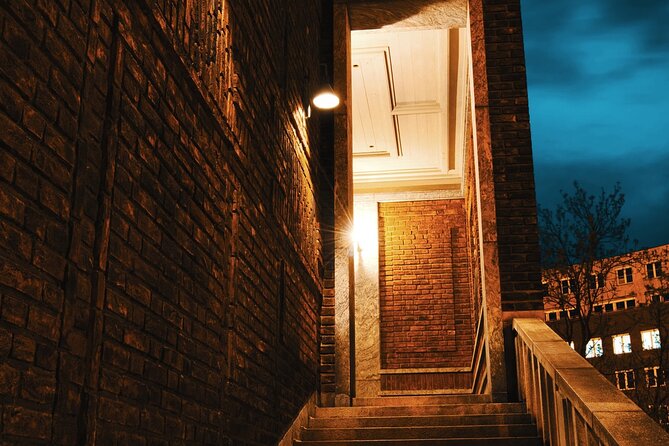
Oslo can seem clean, modern, and neatly planned at first glance. This walk helps you look again. Beneath the practical city are old beliefs, religious symbols, military walls, local superstitions, and tales of restless spirits.
I like this approach because it does not treat folklore as a separate stage show. The stories are tied to squares, gates, fortifications, and churches. You are not simply listening to a guide recite dates. You are hearing stories in the places where Oslo’s past took shape.
The tour also gives you a useful introduction to Norwegian ways of thinking about luck, protection, death, and the unknown. The emphasis is on storytelling, but you still pick up facts about Oslo’s buildings and development along the way.
The title may set your expectations too high if you want a frightening ghost walk. One rating specifically noted that the stories were not especially dark. That is worth taking seriously. I would choose this for folklore, local culture, and a lively introduction to the city, not for a night of horror.
More Walking Tours in Oslo
- Oslo: Best of Oslo Walking Tour
★ 4.5 · 458 reviews - Oslo: Guided Walking Tour of Central Oslo
★ 4.7 · 438 reviews - Oslo: Historic Myths & Legends Evening Walking Tour
★ 4.8 · 408 reviews
Starting outside Oslo City Hall at 6 p.m.
The meeting point is Fridtjof Nansens plass 8, near Oslo City Hall. The first stop is outside only, with about 15 minutes devoted to Viking beliefs and their view of the world.
That opening matters because it gives the rest of the tour a theme. Viking ideas were not limited to famous warriors and longships. They included explanations for natural forces, fate, danger, and the unseen world. The guide uses those beliefs as a doorway into Norwegian culture.
You will want to arrive ready to listen rather than expecting a long architectural tour of City Hall. The building is a starting point and a setting for the first stories, not an indoor visit. Since the tour begins at 6 p.m., check the local time carefully and allow enough time to find the meeting place.
The opening is also a good test of the guide’s style. Several comments praise guides for making the information funny, warm, and easy to remember. One guide, Marija, was singled out for keeping the group involved and making the material feel relatable. That kind of delivery is especially helpful when the subject includes unfamiliar names, beliefs, and legends.
Christiania Torv and Oslo’s signs of bad luck
From City Hall, the walk continues to Christiania Torv, where the group spends about 20 minutes. This section focuses on ghostly apparitions and old superstitions.
The useful part here is the link between belief and daily life. Superstitions were not simply spooky entertainment. People treated signs as warnings or protection against bad luck. That gives you a more human way to think about the past. It shows how ordinary people tried to feel safer in a world they could not fully explain.
Christiania Torv also helps shift the tour from broad Viking ideas to local Oslo stories. The guide can point out how the city’s older spaces collect memories and legends over time. You get a sense of how a square can carry more than one identity: public meeting place, historic setting, and supposed home to strange happenings.
This is one of the more atmospheric portions of the walk, but do not expect a theatrical haunted-house presentation. The emphasis is on tales connected to the area and on the role of superstition in local culture. If you prefer legends with historical context, you should enjoy this stop. If you want frightening effects, it may feel mild.
Fifty minutes around Akershus Castle and Fortress
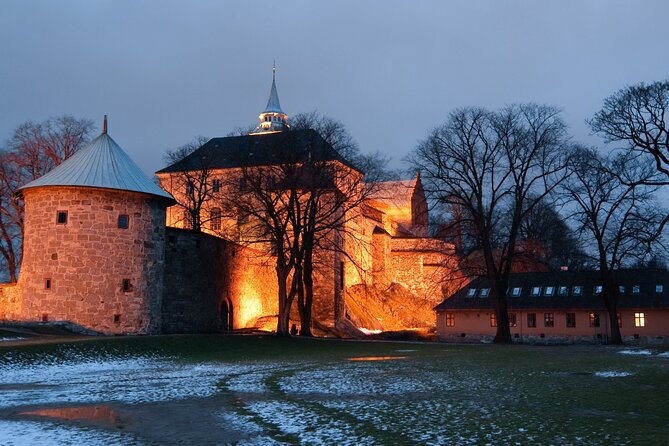
Akershus Castle and Fortress receives the longest portion of the tour, about 50 minutes. That is sensible. It is the most substantial stop on the route, and it offers both architecture and stories.
The fortress dates from the late 13th century, and its powerful appearance gives the ghost tales a fitting setting. The tour explains stories associated with the site while you take in its heavy walls and imposing form. The description says the architecture has remained unchanged since construction, which gives this part a strong visual link to Oslo’s medieval past.
You should not confuse this stop with a full museum visit. Admission is listed as free, but the tour information does not promise an indoor entry or a separate castle ticket. Expect to hear the guide’s account of the fortress and its legends while viewing the site as part of the walking route.
The long stop is a major strength for anyone who wants more than a quick photo. You have time to listen, ask questions, and connect the tales to the building. It is also the point where pacing matters most. One person found the guide so enthusiastic that stories sometimes began before the whole group had arrived. Keep an eye on the guide and stay close, especially if you stop to take photographs.
Akershus is likely to be the highlight for visitors who enjoy military buildings, royal associations, and ghost stories with a real historical setting. It may be less appealing if you want constant movement. Nearly half the tour’s time is concentrated here, so the walk is not five equal stops.
A completely different kind of day out from Oslo:
- Oslo: Scenic Fjord Cruise with Audio Guide Commentary
★ 4.5 · 5,375 reviews - Oslo Nature Walks: Island Hopping Tour
★ 4.8 · 2,713 reviews - Oslo: 100% Electric Oslofjord Sightseeing Cruise
★ 4.4 · 2,041 reviews - Oslo: Fjord Evening Cruise with Shrimp Buffet
★ 4.5 · 1,956 reviews
Kvadraturen reveals Oslo’s older street plan
The route then moves into Kvadraturen, with around 20 minutes devoted to hidden secrets and the mix of medieval and classic architecture.
The name refers to the neighborhood’s grid-like layout, but you do not need to know that in advance to appreciate the area. The value of this stop comes from looking closely at streets you could easily cross without noticing. The guide draws attention to older corners, building details, and stories that help explain Oslo’s early urban character.
This is where the tour feels most like a discovery walk. You are not only visiting famous landmarks. You are learning how to read the city’s less obvious clues. The blend of older and later architecture also makes the stop useful for understanding how Oslo changed over time.
I would pay attention to the transitions here. A good guide can make the neighborhood feel connected rather than random, showing how myths, buildings, and public life overlap. Since the stop lasts only about 20 minutes, do not expect a full architectural survey. Think of it as a focused introduction that may help you explore Kvadraturen more carefully later.
Ending near Oslo Cathedral and Karl Johans gate
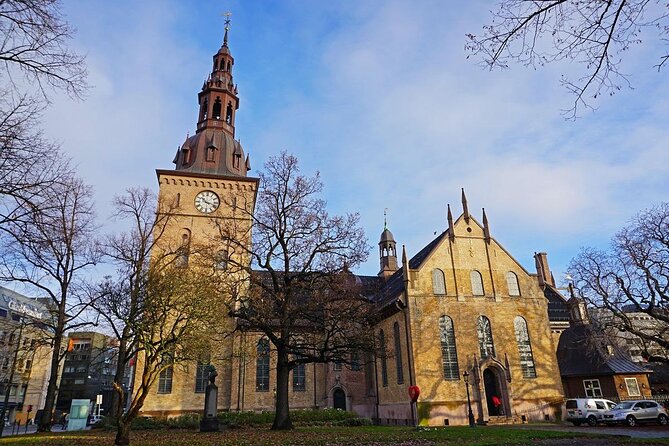
The final stop is Oslo Cathedral, with about 15 minutes outside. The cathedral dates to 1697 and is known for Baroque decoration and tall spires rising above Stortorget Square.
This is a strong ending because it brings the walk back to a major central landmark after the medieval fortress and older neighborhood streets. The cathedral’s formal appearance gives the final part a different mood from the ghost stories and Viking beliefs. You can consider how religion, ceremony, and city identity shaped Oslo alongside folklore and military power.
The stop is outside only. If you want to see the interior, its decoration, or any religious artwork, plan a separate visit. The tour ends at Stortorvet, near Karl Johans gate and Oslo Cathedral, so you are left in a convenient central area rather than at a remote edge of town.
That finish is practical. You can continue along Karl Johans gate, find food nearby, or use public transportation. The tour information confirms that the route is near public transportation, though it does not provide a specific station or travel time.
Guide style matters more than the script
The strongest praise for this experience focuses on the guides. Marija was described as warm, funny, and able to make the information stick. Maria was praised for combining strong subject knowledge with entertaining stories. Ihor was noted for enthusiasm, though that same energy sometimes affected the pace.
That tells you what kind of experience this is. The tour depends on a human storyteller. You are not receiving a fixed audio track or walking silently from one plaque to another. A lively guide can make the meaning of a statue or building memorable, while a rushed guide can leave part of the group trying to catch up.
I like the fact that the information appears to go beyond ghost stories. The walk includes Nordic history, local architecture, Viking beliefs, the meaning of statues, and aspects of Norwegian life. One comment said the tour helped explain the significance of structures, not just their appearance.
The best practical advice is simple: stay near the guide, especially when moving between stops. If you need more time for photographs, take them quickly or do a second pass after the tour. This is a walking story session, not a slow photography tour.
Is $42.98 a fair price?
At $42.98 per person, this is not the cheapest way to walk around central Oslo. The main value is not admission. The listed stops have no separate admission charge as part of the tour, and two locations are outside only.
You are paying for the guide’s interpretation, route planning, and storytelling. That can be worthwhile in Oslo, where a good explanation can turn a square or fortress wall into something memorable. The small maximum group of 16 also helps justify the cost compared with a large city walk.
I would call the price fair for you if you enjoy guided storytelling and want a compact introduction to Oslo’s old beliefs and central sights. It is less compelling if you mainly want entry to buildings, a detailed architectural lecture, or a long free walk with occasional facts.
The two-hour length helps the value. You get a focused evening activity without giving up an entire day. Since it is often booked about 38 days ahead, you may want to reserve early if your Oslo dates are fixed, especially if the small group matters to you.
Who should book this Oslo walk?
I would recommend it to first-time visitors who want a quick orientation with personality. It is also a good fit for families with older children, couples, solo visitors, and anyone who enjoys folklore more than formal museum tours.
You should book it if you like:
- Ghost stories with a local setting
- Viking beliefs and Nordic culture
- Historic fortresses and old city streets
- Guides who tell stories with humor and energy
- A short evening activity in central Oslo
- Walking routes that include familiar sights and less obvious details
You may want something else if you need wheelchair-specific route information, since only a moderate level of physical fitness is stated and no detailed surface or step information is provided. Service animals are allowed.
The tour is offered in English and uses a mobile ticket. Free cancellation is available up to 24 hours before the start time, but cancellations or changes inside that window are not accepted for a refund.
My final take on Myths and Legends
I like this tour because it gives Oslo a human voice. The route is compact, the subjects are varied, and Akershus Castle and Fortress receives enough time to feel important rather than rushed.
The main caution is the title. Expect amusing, curious, and sometimes eerie stories, but not necessarily a dark or frightening night. If you approach it as a folklore and city-history walk, the experience offers good value and a memorable way to see central Oslo.
I would book it early for a first or second evening in the city, especially if you want a warm guide, a small group, and a quick introduction to places you might otherwise pass without much thought.
FAQ
How long does Myths and Legends: An Oslo Walking Discovery last?
The tour lasts approximately two hours.
What time does the tour begin?
The tour begins at 6:00 p.m.
Where does the tour start?
It starts at Fridtjof Nansens plass 8, 0160 Oslo, Norway.
Where does the tour end?
It ends at Stortorvet, near Karl Johans gate and Oslo Cathedral.
Is the tour offered in English?
Yes. English is the stated tour language.
How much does the tour cost?
The listed price is $42.98 per person.
Is entry to the stops included?
The stops are listed with free admission. Oslo City Hall and Oslo Cathedral are outside-only visits, and the tour details do not promise indoor entry to Akershus Castle and Fortress.
How many people can join the tour?
The tour has a maximum group size of 16 people.
Is the tour suitable for someone with limited fitness?
A moderate level of physical fitness is required. More detailed information about surfaces, steps, or route accessibility is not provided.
Can I cancel for a full refund?
Yes, you can cancel up to 24 hours before the experience start time for a full refund. Cancellations and changes made less than 24 hours before the start are not accepted for a refund.
Just added around Oslo
- Oslo: 3-hour Cross Country trip with equipment and guide★ 5.0 · 4 reviews
- Visit the Instaworthy Spots of Oslo’s Vigeland Park with a Local★ 5.0 · 4 reviews
- Oslo: 2-hour Christmas Private Walking Tour★ 3.0 · 4 reviews
- Art and Museum Tour of Oslo★ 5.0 · 4 reviews
- Flavors of Oslo: Food & Beer Tour★ 4.8 · 4 reviews
- Private Transfer from Oslo City Centre to Oslo Airport★ 5.0 · 4 reviews
- 3-Hour Vattkørt Beginner Kayak Course on Oslo Fjord★ 5.0 · 4 reviews
- Hipstoric Grünerløkka Private Walking Tour★ 5.0 · 4 reviews
Walking Tours, compared.

Past & Present Small Group Guided Walking Tour
Read our review →
Walking Tour in Bergen of the Past and Present
Read our review →


Browse the lists this tour appears in