
Reviewed · WALKING TOURS
Hipstoric Grünerløkka Private Walking Tour
Oslo reveals its character one street at a time. This private three-hour walk takes you from political Youngstorget through old industrial quarters, street art lanes, medieval churches, wooden houses, and the food stalls of Mathallen. I especially like the focus on local Oslo life and the chance to explore with only your own group. I also like how the route links culture, politics, art, and everyday neighborhoods rather than ticking off only major sights.
The main consideration is the price: $237.12 per person is a serious outlay for a walking tour, especially for a solo visitor or couple. You are paying for a private guide and a tailored experience, not entrance tickets. The route also requires moderate fitness and continues in all weather, so comfortable shoes and suitable clothing matter.
In This Review
- Key things to know before you book
- Why this route gives you a different Oslo
- Youngstorget and Torggata: Oslo’s public voice
- Kulturkirken Jakob and the walk beside Akerselva
- Crossing the Fairytale Bridge into Grünerløkka
- Olaf Ryes plass and the Edvard Munch connection
- Blå and Brenneriveien: Oslo’s open-air art stops
- Damstredet and Oslo’s wooden hillside houses
- Famous names at Our Saviour’s Memorial Cemetery
- Old Aker Church and Telthusbakken
- Vulkan and Mathallen: a useful ending
- Price, pace, and practical value
- Who will enjoy this private walk most
- Should you book the Hipstoric Grünerløkka tour?
- FAQ
- How long is the Hipstoric Grünerløkka Private Walking Tour?
- Where does the tour start?
- Where does the tour end?
- Is this a private tour?
- What language is the tour offered in?
- Is a guide included?
- Are entrance tickets included?
- Is Mathallen open every day?
- Can you cancel for a full refund?
Key things to know before you book
- Youngstorget sets the political tone: Begin among rally sites, political offices, and the public life of modern Norway.
- Street art is a major feature: Blå and Brenneriveien offer some of the most memorable visual stops on the route.
- You cross Oslo’s green corridor: The Akerselva walk connects the city center with Grünerløkka through parks and paths.
- History appears in unexpected places: Old Aker Church, Our Saviour’s Memorial Cemetery, Damstredet, and Telthusbakken add medieval and nineteenth-century detail.
- The finish is practical: End at Mathallen Oslo in Vulkan, where you can eat or continue exploring Grünerløkka.
- Private guiding is the selling point: You receive a professional English-speaking guide for your group alone, with guides such as Inger and Björn praised for clear, engaging explanations.
Why this route gives you a different Oslo
Central Oslo can feel polished and easy to read. This walk takes you into districts where the city’s political past, working-class roots, creative scene, and newer food culture sit close together. That mixture is the real appeal.
You start at Youngstorget and finish at Vulkan, walking roughly across central Oslo toward Grünerløkka. The route is not a museum tour with long indoor visits. Instead, your guide explains what you are seeing as you move through public squares, streets, parks, cemeteries, church grounds, and former industrial areas.
I like that arrangement for a first or second day in Oslo. It helps you understand how the city fits together. You see where political activity happens, how the Akerselva shaped the city, and why Grünerløkka changed from a working-class district into one of Oslo’s best-known creative neighborhoods.
Because this is a private tour, only your group participates. That can make a real difference on a walking route. You can ask questions about a building, slow down for photographs, or request more detail about art, politics, architecture, or local life. The tour is offered in English.
More Walking Tours in Oslo
- Oslo: Best of Oslo Walking Tour
★ 4.5 · 458 reviews - Oslo: Guided Walking Tour of Central Oslo
★ 4.7 · 438 reviews - Oslo: Historic Myths & Legends Evening Walking Tour
★ 4.8 · 408 reviews
Youngstorget and Torggata: Oslo’s public voice
Youngstorget is a useful starting point because it introduces Oslo as a political city, not just a collection of royal buildings and waterfront attractions. Political speeches and rallies take place here, including events connected with women’s rights and gay pride. The square is also close to the Government quarter, so political organizations have offices nearby.
Your guide spends about ten minutes here. That is enough to establish the setting without turning the opening into a long lecture. I would pay attention to how the square functions today, since its importance comes from public gatherings and civic life as much as from architecture.
The next stop is Torggata, whose name translates as Square Street. It is also represented in the Norwegian edition of Monopoly, an amusing detail that gives the street a place in popular culture as well as the city map. You have another ten-minute stop here, likely enough for orientation and a few photographs.
These first two stops work best if you enjoy context. They are not grand monuments with a dramatic entrance. Their value lies in understanding how Oslo residents use familiar public spaces.
Kulturkirken Jakob and the walk beside Akerselva

Kulturkirken Jakob, or the Culture Church, changes the mood. This church is rented long-term by Kirkelig Kulturverksted and used for theatre, concerts, dance, and other cultural events. It is one of the few churches in Norway devoted to this kind of cultural program.
You spend about ten minutes here. The stop is especially appealing if you like places where old buildings gain a new purpose. The church is not presented only as a religious site. It also shows how Oslo uses an existing structure for the arts.
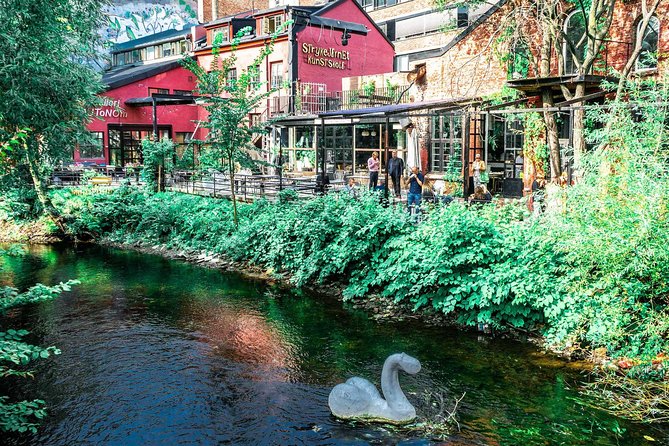
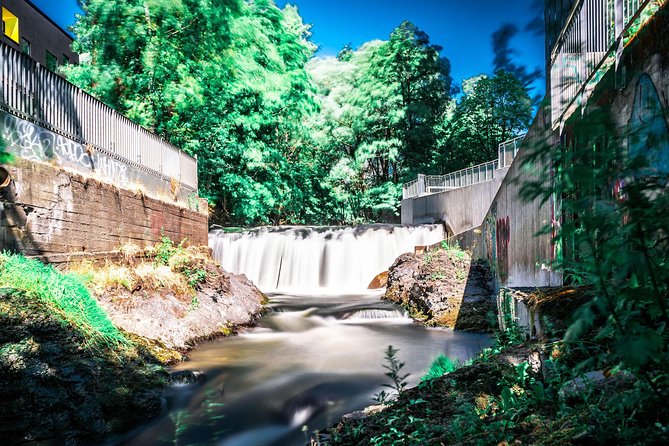
From there, the route reaches the Akerselva River. Oslo calls the river its green lung because parks and nature paths run along its banks. The river is an important transition point in the walk. You leave the central streets and begin following a quieter corridor toward Grünerløkka.
Do not expect a long riverside hike at this point. The scheduled stop is about ten minutes, and the entire tour lasts about three hours. Still, this section helps you see why the river matters to Oslo’s layout and daily life. Wear shoes with good support, since a walking tour that crosses several districts can feel more demanding than the stop-by-stop timing suggests.
Crossing the Fairytale Bridge into Grünerløkka
Once you cross the Akerselva and the Fairytale Bridge, you officially enter Grünerløkka. This district began as a traditional working-class area. During the late twentieth century, it went through gentrification and became associated with cafés, music, art, design, and independent city life.
The guide’s role matters most here. A quick self-guided walk can show you attractive streets, but it may not explain how the neighborhood changed. The tour connects the old industrial and working-class character with the newer creative identity.
I would not treat Grünerløkka as a single uniform area. The route shows several sides of it, from historic housing and parks to street art and food culture. That range is one reason the private format can be useful. You are not simply stopping for a photograph and moving on. You can ask how the district developed and how locals use it now.
A completely different kind of day out from Oslo:
- Oslo: Scenic Fjord Cruise with Audio Guide Commentary
★ 4.5 · 5,375 reviews - Oslo Nature Walks: Island Hopping Tour
★ 4.8 · 2,713 reviews - Oslo: 100% Electric Oslofjord Sightseeing Cruise
★ 4.4 · 2,041 reviews - Oslo: Fjord Evening Cruise with Shrimp Buffet
★ 4.5 · 1,956 reviews
Olaf Ryes plass and the Edvard Munch connection
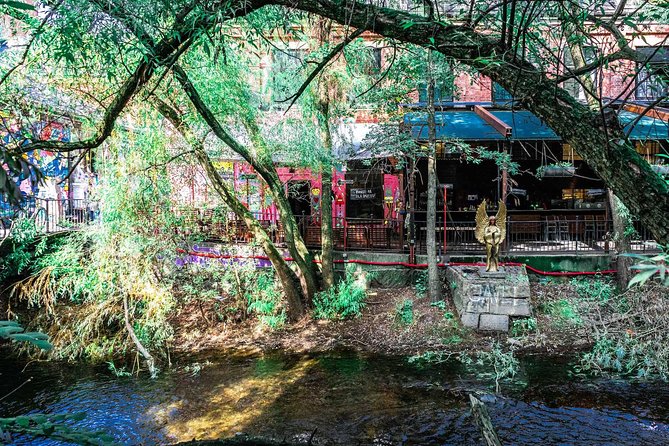
Olaf Ryes plass is surrounded by three- and four-story buildings, many built in the late 1800s. The park gives you a good look at Grünerløkka’s older residential character, while Parkteatret nearby represents its current music and entertainment scene.
A young Edvard Munch lived in one of the surrounding buildings. That detail adds a personal link to the area. Munch is one of Norway’s best-known artists, but here the connection is tied to an ordinary neighborhood rather than a formal gallery.
You have about ten minutes at the square. It is a compact stop, so I would use the time to look up at the buildings around the park rather than focusing only on the guide. The surrounding streets help explain why Grünerløkka appeals to people interested in architecture, urban change, and Oslo’s arts scene.
Blå and Brenneriveien: Oslo’s open-air art stops
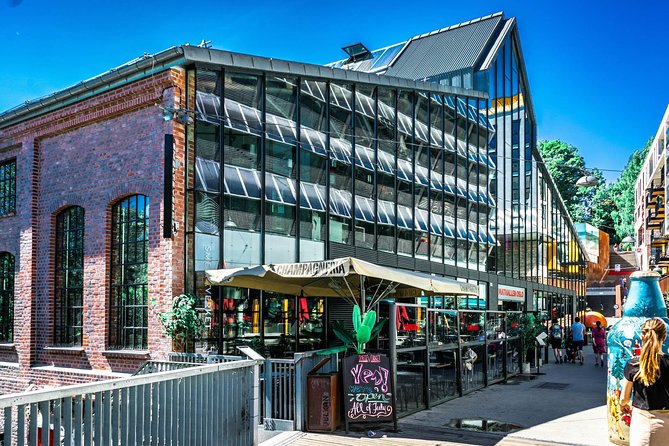
The section around Blå is one of the strongest parts of the route for anyone who enjoys street art. Blå is an alternative music venue, and the nearby area is known for its street art. Bring your camera, but remember that this is an outdoor public setting, so the exact appearance can change.
Brenneriveien continues the art theme. Old, unused industrial buildings have been transformed into a street art area by local art students. The contrast is the point: plain industrial structures become a surface for experimentation and color.
Each stop is scheduled for about ten minutes. That makes this part energetic rather than exhaustive. You get a concentrated look at the area, but you will not study every mural or spend hours inside a gallery. If street art is a major reason for booking, ask your guide questions and allow yourself time to take in the details.
The industrial setting also adds useful context. This is not art placed in a spotless exhibition hall. It appears alongside older buildings and working remnants of the city, which makes the route feel more connected to everyday Oslo.
Damstredet and Oslo’s wooden hillside houses
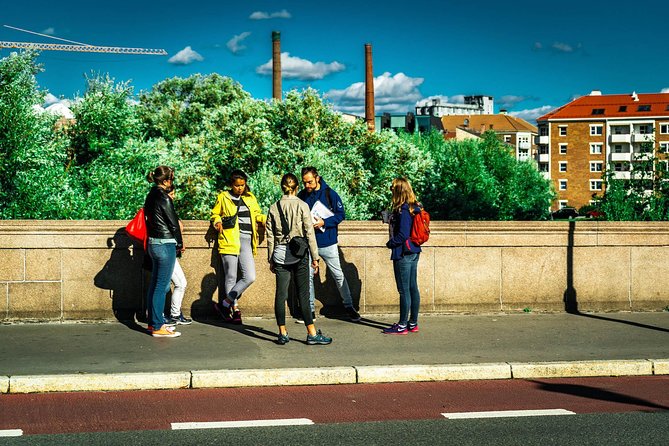
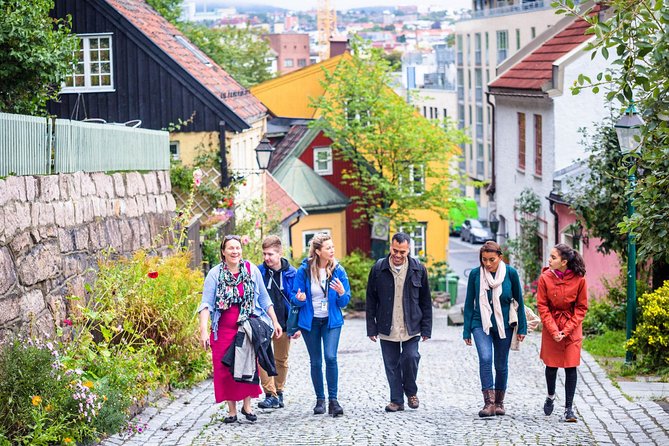
Damstredet offers a sharp change from street art and industrial buildings. Its well-preserved wooden houses climb the hillside, and the homes are still inhabited. The result is a charming photo stop with a more intimate scale.
This is the sort of place where you should remember that people live there. Take photographs respectfully and avoid blocking the narrow street. The ten-minute stop gives you time to notice the colors, rooflines, and hillside arrangement.
Damstredet works well in the middle of the tour because it prevents the route from becoming only a modern culture walk. Oslo’s identity here is layered. A former working-class district can contain old homes, contemporary art, music venues, and new food spaces within a relatively short walk.
Famous names at Our Saviour’s Memorial Cemetery
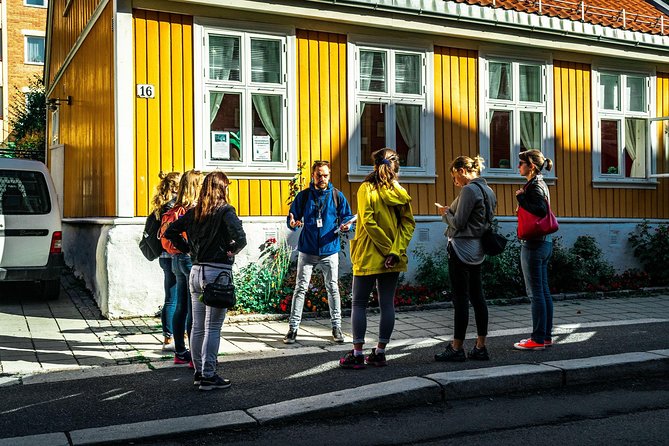
Our Saviour’s Memorial Cemetery is a quieter stop and receives about fifteen minutes, the longest scheduled pause on the route. Our Saviour’s Church is the resting place of notable Norwegians, including playwright Henrik Ibsen and painter Edvard Munch.
The cemetery gives you a chance to slow down. After the visual noise of street art and city streets, this is a more reflective setting. The connection between Munch’s former neighborhood home and his grave also gives the tour a clear thread.
I like the fact that the route does not treat famous names as isolated facts. You encounter Munch in the context of where he lived and where he was later buried. Ibsen adds another major Norwegian cultural figure to the same setting.
Old Aker Church and Telthusbakken
Old Aker Church, or Gamle Aker Kirke, is Oslo’s oldest remaining building and the only remaining medieval church in the city. The stop lasts about ten minutes, so the emphasis is on seeing the site and understanding its place in Oslo’s long past.
This is one of the most historically important points on the walk, but it is not presented as a separate full church tour. If you want extensive architectural detail or a long interior visit, keep your expectations modest. Its strength is how naturally it fits into a neighborhood walk.
Nearby Telthusbakken brings you back to colorful wooden houses. Edvard Munch painted the street, and around fifty people live on one side today. Allotment gardens occupy the other side, adding a small-scale, lived-in quality.
Telthusbakken is another good photo stop, but it also gives you a look at how older housing and gardens remain part of the city. The ten-minute visit is short, so you will want to look carefully as you walk. The colorful houses are the obvious draw, while the allotment gardens provide an unusual contrast in a central Oslo district.
Vulkan and Mathallen: a useful ending
The tour ends at Vulkan, an urban development project built in an area that was once heavily industrial along the Akerselva. Mathallen Oslo is the final stop and offers food from many sources and styles.
This is a smart ending. You finish with somewhere practical to eat, rather than being dropped at an anonymous street corner. Mathallen is also a good place to continue your time in Grünerløkka if you still have energy.
Mathallen is closed on Mondays, so plan around that if you are counting on food after the walk. The tour itself ends at Vulkan, and you can make your own way back to Youngstorget. Walking takes about fifteen minutes, or you can use public transport. Your public transport ticket is not included.
The final stop lasts about ten minutes in the tour plan, but you can continue enjoying the area afterward. That flexibility adds value, especially if you want to turn the walking tour into a longer neighborhood visit.
Price, pace, and practical value
At $237.12 per person, this is expensive compared with a standard group walking tour. The price makes more sense for a family, group of friends, or small private party that values a guide focused only on them. Group discounts are available, so check the final rate for your party before deciding.
You are not paying for admission tickets. All listed stops are free, and the professional guide is the main included service. The value comes from the route design, the local explanations, and the private format.
The tour lasts approximately three hours. That is a useful length for a half-day plan, but the many ten-minute stops mean the pace is active. You cover political squares, streets, the river, parks, residential areas, cemeteries, churches, and former industrial districts. You should expect steady walking rather than long periods of sitting.
The tour operates in all weather. Oslo weather can change, so dress comfortably and appropriately. Service animals are allowed, and the route is near public transportation. The stated fitness level is moderate, which is worth taking seriously because the walk includes several districts and hillside streets.
Free cancellation is available if you cancel at least 24 hours before the start time. Changes or cancellations made less than 24 hours in advance are not accepted for a refund.
Who will enjoy this private walk most
I would choose this tour if you have already seen Oslo’s headline sights and want a better feel for its neighborhoods. It also suits a first-time visitor who prefers social history, local streets, art, and architecture over a long museum visit.
You will likely enjoy it most if you:
- Like street art, music venues, and creative districts
- Want a private guide rather than a large group
- Enjoy asking questions about politics, culture, and city change
- Can walk steadily for about three hours
- Want to finish near food and public transport
- Are comfortable exploring outdoors in changing weather
It may be less suitable if you want extensive time inside museums, a slow café-centered outing, or a tour built around major royal and national sights. The route is also costly for a small party. For a larger group using the available discount, the private format becomes easier to justify.
The strongest part of the experience is the guiding. Inger received especially warm praise for her passion and explanations of the district’s culture and history. Björn was also described as highly informative, and the feedback repeatedly points to guides who answer questions well and add facts you might not discover by walking alone.
Should you book the Hipstoric Grünerløkka tour?
Book it if you want Oslo explained through its neighborhoods. The route gives you politics at Youngstorget, a river corridor, Grünerløkka’s changing identity, street art at Blå and Brenneriveien, Munch connections, old wooden houses, a medieval church, and food at Mathallen.
I would be more cautious if price is your main concern. Since the sights are free, the $237.12 per person is paying mainly for private attention and interpretation. For a group that wants an informed, flexible walk, that can be worthwhile. For one or two people on a tight budget, a less costly group option may be better.
FAQ
How long is the Hipstoric Grünerløkka Private Walking Tour?
The tour lasts approximately three hours.
Where does the tour start?
It starts at Youngstorget in Oslo, Norway.
Where does the tour end?
It ends at Mathallen Oslo, at Vulkan 5, 0178 Oslo.
Is this a private tour?
Yes. Only your group participates in the activity.
What language is the tour offered in?
The tour is offered in English.
Is a guide included?
Yes. A professional guide is included.
Are entrance tickets included?
The listed stops have free admission, and no separate admission tickets are included or required for those stops.
Is Mathallen open every day?
Mathallen is closed on Mondays.
Can you cancel for a full refund?
Yes, if you cancel at least 24 hours before the experience start time. Cancellations made less than 24 hours before the start time are not refunded.
Just added around Oslo
- Oslo: 3-hour Cross Country trip with equipment and guide★ 5.0 · 4 reviews
- Visit the Instaworthy Spots of Oslo’s Vigeland Park with a Local★ 5.0 · 4 reviews
- Oslo: 2-hour Christmas Private Walking Tour★ 3.0 · 4 reviews
- Art and Museum Tour of Oslo★ 5.0 · 4 reviews
- Flavors of Oslo: Food & Beer Tour★ 4.8 · 4 reviews
- Private Transfer from Oslo City Centre to Oslo Airport★ 5.0 · 4 reviews
- 3-Hour Vattkørt Beginner Kayak Course on Oslo Fjord★ 5.0 · 4 reviews
- Oslo & Vigeland Park Private Walking Tour★ 4.5 · 5 reviews
Walking Tours, compared.
Past & Present Small Group Guided Walking Tour
Read our review →
Walking Tour in Bergen of the Past and Present
Read our review →

Browse the lists this tour appears in