
Reviewed · AUDIO TOURS
Trondheim’s Inner Circle: A Self-Guided Audio Tour
Trondheim reveals itself on foot. This $7.99 audio tour gives you a clear route through the city’s old center, and I like its lifetime access and offline maps. I also like the pleasant narration and short, useful history lessons, which make the walk feel informed without turning it into a lecture.
The main drawback is the app. GPS can drift, and one person had trouble starting the tour near a fenced-off festival area. You should download everything before arriving and know how to use the force start option if the signal refuses to cooperate.
At about 60 to 90 minutes, this is a good first look at Trondheim rather than a full city tour. It suits independent visitors who want to walk alone, pause for photos, and move at their own pace.
In This Review
- Key points about Trondheim’s Inner Circle
- Why this short walk works well in Trondheim
- Following Olav Tryggvason into Trondheim’s beginnings
- Munkegata and the wooden palace of Stiftsgården
- Narrow streets, parks, churches, and the old waterfront
- The 1681 fire and Trondheim’s Baroque rebuilding
- The Old Town Bridge, known as the gate of happiness
- Kristiansten Fortress and its difficult wartime story
- The Archbishop’s Palace and the power of Nidaros
- How the VoiceMap app handles the route
- Price, pace, and who gets the best value
- Should you book Trondheim’s Inner Circle?
- FAQ
- How much does Trondheim’s Inner Circle cost?
- How long does the audio tour take?
- What language is the tour offered in?
- Where does the tour end?
- What is included in the tour?
- Do I need to provide my own phone?
- Are admission fees included?
- Can I cancel for a full refund?
Key points about Trondheim’s Inner Circle
- A low-cost introduction: At $7.99 per person, the tour costs less than many guided walks and never expires after downloading.
- A strong central route: You pass Stiftsgården, the Old Town Bridge, the Archbishop’s Palace, the riverfront warehouses, Kristiansten Fortress, and Nidaros Cathedral.
- Useful offline access: The VoiceMap app includes audio, maps, and location data that can be used without a mobile connection.
- Good for independent walkers: You control the pace, stop for food or photos, and take the tour privately with only your own group.
- History with a clear thread: The narration links Viking beginnings, royal power, city fires, military defense, and Norway’s most important church.
- A few technical risks: GPS may show you off route when you are actually in the right place, and the starting point can be awkward if an event blocks access.
Why this short walk works well in Trondheim
Trondheim’s center is compact enough to explore on foot, but its story is larger than the streets suggest. Viking kings, medieval pilgrims, wealthy merchants, royal residents, wartime prisoners, and modern visitors all left their mark here.
This tour gives you a practical way to connect those stories. Instead of wandering past a wooden palace or old wharf without context, you learn why it matters and how it fits into Trondheim’s past.
The route is offered in English and takes roughly one hour to one hour and 30 minutes. That range matters. If you walk steadily and stop only briefly, you may finish near the shorter estimate. If you pause for pictures, look around the sites, or take a wrong turn, allow closer to 90 minutes.
I see the tour as a useful first walk on arrival. It shows you the core sights, then leaves you free to return to the places that catch your eye. It is not designed to replace a full museum visit or an in-depth cathedral tour.
A few more trips worth weighing up
- Trondheim’s Regalia Self-Guided Tour of Norway’s Historic Centre
★ 5.0 · 9 reviews - Trondheim: Audio Guide Panorama Bustour
★ 4.0 · 9 reviews - Oslo: Scenic Fjord Cruise with Audio Guide Commentary
★ 4.5 · 5,375 reviews
Following Olav Tryggvason into Trondheim’s beginnings
The story begins with Olav Tryggvason, the king who founded Trondheim in 997. He ruled Norway from 995 to 1000 and is also remembered for building the first Christian church in Norway.
That opening gives the walk a firm sense of place. Trondheim is not simply an attractive Norwegian city with old buildings. Its center grew from royal ambition, Christian conversion, trade, and control of an important part of the country.
If you have read the old Icelandic sagas, Olav Tryggvason’s name may already be familiar. The audio commentary places him at the start of the city’s story, helping you picture the early link between kingship and religion.
The strength of this section is its simplicity. You get enough background to understand why Trondheim matters without having to memorize a long list of dates. The limitation is that the tour cannot cover every part of the city’s early medieval past in detail. For that, you would need more time at the cathedral or a museum.
Munkegata and the wooden palace of Stiftsgården
One of the route’s most impressive stops is Stiftsgården, on Munkegata. This large Baroque wooden building was built between 1774 and 1778 for Lady Cecilie Christine Schøller, the widow of chamberlain Stie Tønsberg Schøller.
Schøller belonged to Trondheim’s wealthy trading class, and his widow was a prominent figure in the city’s social world. Her house reflects that position. With more than 100 rooms, Stiftsgården is the largest wooden palace in Northern Europe.
The building has served as Trondheim’s royal residence since 1906. That makes it more than a grand old home. It connects the city’s merchant wealth with the Norwegian monarchy and gives you a sense of how power shifted across the centuries.
I like this stop because it is easy to overlook the story behind a handsome facade. The audio helps you read the building as part of Trondheim’s social history, not just as a large timber structure.
The tour passes the residence, but admission fees are not included. If you want to go inside, treat that as a separate visit and allow extra time. The self-guided walk is best understood as an outdoor introduction.
Narrow streets, parks, churches, and the old waterfront
After Munkegata, the route leads through narrow streets, parks, and medieval churches before reaching the historic waterfront. These changes in setting keep the walk from feeling like a string of unrelated monuments.
The wooden buildings are especially important to the character of central Trondheim. They show how much of the city’s identity comes from timber construction, trade, and rebuilding after disaster.
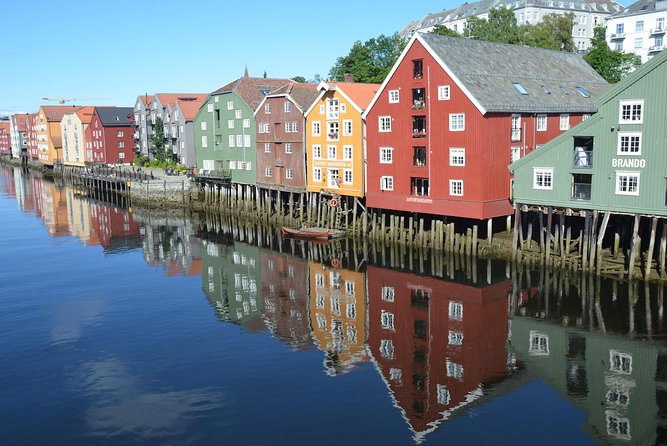
At the riverfront, colorful warehouses line the water. Their position tells you something practical about Trondheim’s past: the river was a working route for merchants and goods, not merely a pretty place for a stroll.
This is likely one of the most pleasant parts of the walk. The waterfront provides attractive views and a change of pace after the streets around the palace. It is also a good place to stop the audio briefly, take pictures, and get your bearings.
The route does not provide food or drinks, so plan your own stop if you want one. Since the tour never expires once downloaded, you do not need to force the whole walk into one continuous session.
A completely different kind of day out from Trondheim:
- Trondheim Like a Local: Customized Private Tour
★ 4.7 · 92 reviews - Trondheim : Explore the city of kings with a local guide
★ 4.8 · 70 reviews - Trondheim: 2-hour City Walking Tour
★ 4.2 · 51 reviews - Trondheim: Discover the city of kings with a local guide
★ 5.0 · 41 reviews
The 1681 fire and Trondheim’s Baroque rebuilding
The audio explains the devastating city fire of 1681 and what followed. Fire changed Trondheim’s layout and led to a Baroque reconstruction, giving the center much of its later form.
This is one of the most useful parts of the tour because rebuilding explains why the city can feel both old and planned. A medieval city was not simply preserved intact. It was damaged, redesigned, and rebuilt according to new ideas about streets and urban order.
You will hear how the fire shaped the city as you continue toward the Old Town Bridge and Kristiansten Fortress. That historical sequence gives the walk a clear rhythm: foundation, growth, destruction, rebuilding, and defense.
A self-guided audio tour is well suited to this kind of story. The streets alone cannot explain a fire that happened centuries ago, but the narration can point out why the present-day arrangement looks the way it does.
The Old Town Bridge, known as the gate of happiness
The Old Town Bridge is one of the route’s memorable visual stops. It is also known as the gate of happiness, a charming name that adds a lighter note to the city’s often serious history.
The bridge helps you understand Trondheim from the river up. It links the old center with the district beyond the water and offers views of the warehouses and surrounding streets.
I would slow down here rather than rush through because bridges are useful viewing points. You can look back at the route, see how the river shaped the city, and take in the contrast between timber buildings and later structures.
The tour’s GPS guidance should help you move in the right direction, but you should still keep an eye on the map. One person found that the phone repeatedly showed the route drifting even when the correct path was being followed.
Kristiansten Fortress and its difficult wartime story
Kristiansten Fortress sits on a hill above the city. It was built after the 1681 fire, partly to watch over Trondheim and partly because the location offered a strong military position.
The fortress later helped protect the city from Swedish conquest in 1718. That gives the hilltop more importance than its views alone. It was built as a defensive answer to a real threat.
Its story turns darker during the Second World War. Nazi forces took over the fortress and executed 23 Norwegian patriots inside it. Today, the site is a museum, and a dungeon is open for viewing.
The audio introduces this difficult history while you walk. It is a reminder that Trondheim’s landmarks are not all decorative or royal. Some carry painful memories that deserve a slower, more respectful look.
The tour notes that a flag flying over the fortress means it is open to the public. Admission is not included, so check the flag if you are considering an extra visit. The route itself does not promise entry or a full fortress tour.
The climb also deserves practical thought. The information provided does not give a detailed accessibility assessment, but the fortress is on a hill. If you prefer a level walk, pay attention to the route and allow extra time.
The Archbishop’s Palace and the power of Nidaros
The walk continues through the grounds of the Archbishop’s Palace. This is where church authority becomes a major part of Trondheim’s story.
The palace grounds sit beside Nidaros Cathedral, making the final section feel like a move into the spiritual center of the city. You learn about the palace as you walk rather than stopping for a long indoor presentation.
Nidaros Cathedral is the grand finale. It is the northernmost Gothic cathedral in the world and was built over the tomb of St. Olav. That location links the cathedral directly to the royal and religious story introduced at the beginning.
The route ends at Kongsgårdsgata 2, 7013 Trondheim, beside Nidaros Cathedral. The cathedral is likely to be the place where you want extra time. The tour brings you there, but cathedral admission is not included.
I like ending here because the route gathers its main themes in one place. Olav Tryggvason’s Christian beginnings, royal authority, pilgrimage, architecture, and Norwegian identity all meet at Nidaros.
How the VoiceMap app handles the route
The VoiceMap application provides the audio, map, and geodata. Once downloaded, the tour has lifetime access and does not expire, which is a strong feature for a flexible trip.
Offline access is especially useful in a walking tour. You can download the material before setting out rather than relying on a live signal in the city center.
The app also offers turn guidance and can alert you if you are moving in the wrong direction. That makes the tour easier to follow than a simple audio file with no map.
Still, you should prepare before reaching the start. Download the app and audio in advance, charge your phone, and check that the route is visible. One couple downloaded it the day before and found the process straightforward, but another person found the download process frustrating.
The starting point can also be affected by local events. During a festival, fencing prevented one person from reaching the exact start location. The app kept saying the user was four meters away, even though the route was blocked. The force start option solved the problem, so learn where that prompt is before you begin.
GPS is not perfect. If the voice says you have wandered off route but you know you are following the street correctly, check the map before turning around. The system may be drifting rather than you.
Price, pace, and who gets the best value
At $7.99 per person, this is inexpensive for a private walking tour with audio, maps, and lifetime access. If you use it only once, it remains a low-cost way to see the central sights. If you return to Trondheim or want to split the walk across two days, the no-expiration policy adds even more value.
You do not pay for a live guide, transport, food, drinks, or entry fees. That keeps the cost down, but it also means you must provide your own phone and manage the walk yourself.
The private format is useful for couples, families, and small groups who do not want to keep up with strangers. You can pause when you like and spend longer at the waterfront, palace, fortress, or cathedral.
The tour is a good fit for:
- Independent visitors who prefer their own pace
- First-time visitors seeking a central orientation walk
- History-minded walkers who want context at each stop
- People with limited time in Trondheim
- Anyone who wants to avoid booking a fixed live tour
It may not suit you if you want a guide to answer questions, help with unexpected closures, or lead you back to the starting point. The walk ends at Nidaros Cathedral and does not include a return route.
Free cancellation is available if you cancel at least 24 hours before the local start time. Cancellations within 24 hours are not refunded, and late changes are not accepted.
Should you book Trondheim’s Inner Circle?
I would book this tour if you want an affordable and flexible introduction to Trondheim’s central sights. The route has a strong historical arc, the audio is generally clear, and the combination of offline access and lifetime use is unusually helpful at this price.
Download the tour before you arrive, and do not depend blindly on GPS. If an event blocks the start, use force start. If the map drifts, trust your eyes and check the route rather than letting the phone boss you around.
Choose something else if you want a live historian, extensive interior visits, or a longer walk with a return to the start. For everyone else, this is a sensible way to connect Trondheim’s wooden streets, river trade, royal buildings, fortress, archbishop’s grounds, and Nidaros Cathedral in one compact outing.
FAQ
How much does Trondheim’s Inner Circle cost?
The tour costs $7.99 per person.
How long does the audio tour take?
The walk takes approximately one hour to one hour and 30 minutes.
What language is the tour offered in?
The tour is offered in English.
Where does the tour end?
The tour ends at Nidaros Cathedral, Kongsgårdsgata 2, 7013 Trondheim, Norway.
What is included in the tour?
You receive lifetime access to the audio tour, the VoiceMap application, and offline access to the audio, maps, and geodata.
Do I need to provide my own phone?
Yes. A smartphone is not included, so you must provide your own device.
Are admission fees included?
No. Personal expenses and admission fees for sites visited during the walk are not included.
Can I cancel for a full refund?
Yes, if you cancel at least 24 hours before the experience start time. Cancellations made within 24 hours are not refunded.
Just added around Trondheim
- Discover the unmissables places of Trondheim★ 4.5 · 6 reviews
- See the city power-walk★ 4.5 · 6 reviews
- 2 Hour City Walk through Trondheim★ 4.5 · 8 reviews
- Trondheim’s Regalia Self-Guided Tour of Norway’s Historic Centre★ 5.0 · 9 reviews
- Trondheim: Audio Guide Panorama Bustour★ 4.0 · 9 reviews
- Explore the beautiful nature of Trondheim★ 5.0 · 11 reviews
- Skiing in winter wonderland★ 4.5 · 12 reviews
- City Bus Tour in Trondheim, Norway★ 3.5 · 13 reviews
Audio Tours, compared.

Scenic Fjord Cruise with Audio Guide Commentary
Read our review →
Molde: Atlantic Ocean Road & Varden Audio Guide Bus Tour
Read our review →

Ålesund and Surrounding Islands Audio Guide Tour
Read our review →

Norwegian Coastal Cities: Smartphone Audio Guide App
Read our review →
Bergen in Your Pocket: Landmarks and Lore Audio Tour
Read our review →Browse the lists this tour appears in